
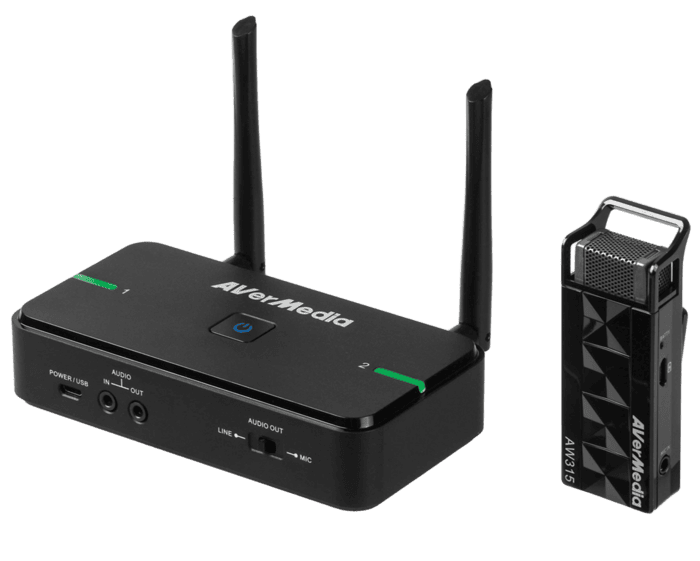
AW315
- 2.4 GHz wireless teacher microphone designed to prevent vocal fatigue
- Operating range up to 20 meters with zero-latency digital transmission
- Onboard DSP howling suppressor and ground loop noise isolation technology
- Rechargeable lithium battery delivering up to 8 hours of continuous use
Specifications
FAQs
How does the AVerMedia AW315 prevent voice strain for educators?
The AW315 allows teachers to speak at a relaxed, natural conversational volume while projecting their voice clearly across the entire classroom through the room’s PA system. This prevents chronic vocal strain, hoarseness, and vocal cord fatigue commonly experienced during long teaching days.
How does the built-in DSP Howling Suppressor protect classroom audio?
Classroom audio systems frequently suffer from high-pitched acoustic feedback when a teacher walks near overhead speakers. The AW315 features a built-in DSP feedback cancellation engine that detects and dampens feedback frequencies in real time, preventing screeching sounds.
Why is the 2.4 GHz digital wireless band advantageous for schools?
The 2.4 GHz band operates globally license-free, avoiding complex UHF frequency coordination. The AW315 utilizes automatic frequency hopping to instantly dodge Wi-Fi and Bluetooth interference, allowing dozens of classrooms in the same school building to run AW315 systems simultaneously without cross-talk.
What is the function of the built-in ground loop noise isolator?
When connecting wireless receivers to existing classroom amplifiers or interactive whiteboards, ground loops can create an annoying electrical background hum. The AW315 receiver incorporates an internal ground noise isolator that eliminates ground hum, delivering clear voice amplification.
How is the AW315 teacher microphone worn and charged during school hours?
Weighing just 32 grams, the microphone pendant can be worn around the neck via an adjustable lanyard or clipped to a shirt pocket. Its built-in lithium battery lasts 8 hours on a single charge and recharges overnight via a standard micro-USB cable.