
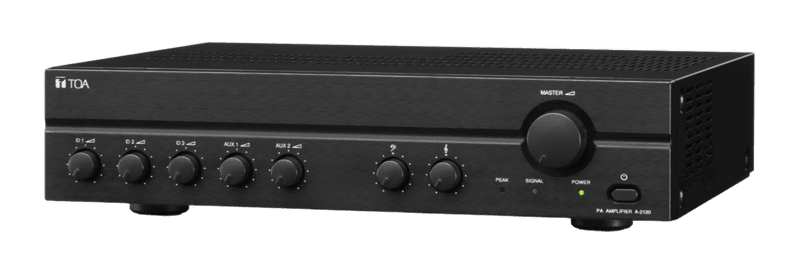
A-2120
- 120W RMS rated power output engineered for medium to large public address speaker installations
- Multi-tap output section supporting 100V Line (83Ω), 70V Line (42Ω), or 4Ω (22V) Direct Speaker Output
- 3 balanced microphone inputs and 2 RCA auxiliary line inputs with discrete volume adjustment
- Automatic MIC 1 priority override mutes background channels during priority public announcements
Specifications
FAQs
What is the main difference between the TOA A-2120 and the TOA A-2060?
The TOA A-2120 provides double the amplifier power output of the A-2060, delivering a full 120W RMS compared to 60W. This increased wattage allows the A-2120 to power larger quantities of 100V ceiling speakers and horn speakers across expanded commercial zones and noisy environments.
How does the 100V line speaker distribution work on the TOA A-2120?
In 100V mode, the A-2120 outputs high-voltage audio that can travel over long cable runs without significant power loss. Multiple 100V transformers on speakers are wired in parallel across the speaker line, provided the combined wattage tap total does not exceed the 120W rating of the amplifier.
Can I connect an external audio recorder to the TOA A-2120?
Yes, the rear panel features a dedicated 0 dB, 600 Ω unbalanced RCA Record Output (Rec Out). This port sends a line-level mix of all active microphones and background music feeds to external USB flash recorders, archiving systems, or secondary amplifiers.
Does the TOA A-2120 feature voice-activated ducking on MIC 1?
Yes, MIC 1 features built-in voice-activated muting. Speaking into the MIC 1 microphone automatically triggers internal circuitry that lowers background music on AUX 1 and AUX 2 by up to 30 dB, guaranteeing that priority emergency pages or security calls are heard clearly.
How does the DC power connection protect commercial public address systems?
The 24V DC screw terminals allow connection to an external 24V emergency battery system. If mains AC power fails during an emergency, the A-2120 seamlessly draws power from the backup batteries, keeping emergency announcements and evacuation alarms operational.