
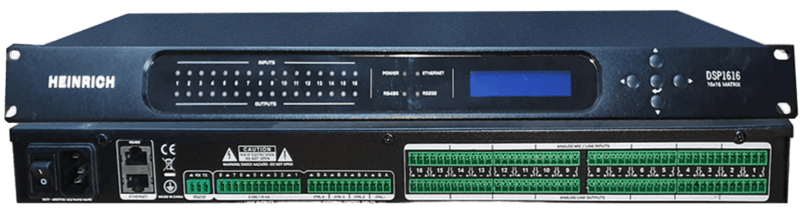
DSP1616
- 16 analog mic/line inputs with phantom power and 16 line outputs on Phoenix terminal blocks
- High-speed 64-bit DSP processor running at 96 kHz sampling rate with 24-bit A/D and D/A conversion
- Full suite of audio processing: AEC, Auto-Gain Control (AGC), Auto-Mixer, Matrix Mixing, and Crossover
- Extensive GPIO control interfaces with 8 logic inputs and 8 logic outputs for system automation
Specifications
FAQs
Why is the 96 kHz sampling rate on the Heinrich DSP1616 important for audio installations?
A 96 kHz sampling rate combined with a 64-bit DSP engine provides double the frequency resolution of standard 48 kHz processors. This results in ultra-low distortion, highly accurate equalization, and pristine high-frequency reproduction, ensuring reference-grade audio clarity across complex multi-zone installations.
How does Acoustic Echo Cancellation (AEC) improve teleconferencing on the DSP1616?
AEC removes speaker audio echoes from returning back into room microphones during video calls. It compares far-end incoming audio with local microphone pickup, instantly subtracting speaker bleed so remote call participants hear clean, intelligible voices without echo loops.
What automated mixing capabilities are built into the Heinrich DSP1616?
The DSP1616 includes onboard Auto-Mixer, Auto-Gain Control (AGC), and Ducker modules. These tools automatically balance voice volume levels across all 16 mic inputs, smooth out variations between loud and soft speakers, and automatically duck background music during live announcements.
What function do the 8x8 GPIO logic ports serve?
The GPIO (General Purpose Input/Output) ports allow the DSP1616 to interface physically with external room equipment. Control inputs can be wired to physical wall buttons to trigger scene presets, while logic outputs can trigger external relays, mute indicators, or motorized projection screens automatically.
How does the automatic power-off save feature protect system settings?
The automatic power-off save function writes all active volume levels, matrix routes, and processing configurations to non-volatile flash memory in real time. In the event of an unexpected power outage, the unit instantly restores its exact operational state as soon as power returns.