
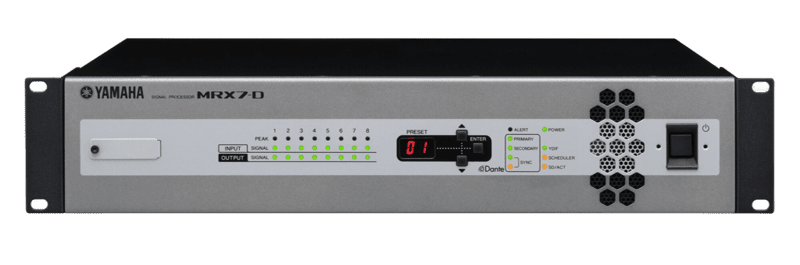
MRX7-D
- 64×64 Dante audio networking channels with redundant primary and secondary RJ45 connection ports
- Built-in 16-channel Dan Dugan automatic microphone mixing engine for seamless multi-speech balancing
- 8 mono mic/line analog inputs and 8 analog line outputs on Euroblock terminal block connectors
- Integrated Mini-YGDAI expansion slot for adding MY series digital I/O or processing cards
Specifications
FAQs
What is the advantage of the integrated Dan Dugan Speech Automixer in the Yamaha MRX7-D?
The built-in 16-channel Dan Dugan automixing engine automatically manages microphone gain distribution across active speakers in real time. It effectively prevents acoustic feedback, eliminates comb filtering, and lowers background room noise without cutting off quiet voices, making it essential for multi-mic boardrooms and conference installations.
How does the Yamaha MRX7-D handle network audio routing over Dante?
The MRX7-D includes primary and secondary Gigabit Ethernet ports that send and receive up to 64×64 uncompressed digital audio channels over Dante IP networks. It fully supports AES67 interoperability and Dante Domain Manager (DDM) for secure, scalable network audio distribution across large enterprise campuses.
Can the MRX7-D play pre-recorded audio messages or chime tones autonomously?
Yes, the MRX7-D features a built-in SD card slot capable of storing and playing WAV or MP3 audio files. These audio tracks can be triggered automatically via GPI inputs, timed schedules, or software commands for automated bell schedules, emergency announcements, and visitor chimes.
What customization software is used to design and manage MRX7-D DSP signal paths?
System integrators design custom audio signal paths using the Yamaha MTX-MRX Editor software on Windows. End users can then control volume, mute, and preset recalls using customizable touch panel interfaces on iPad or PC via the Yamaha ProVisionaire software suite.
What options exist for expanding the physical inputs and outputs of the MRX7-D?
In addition to its 8 analog inputs and 8 analog outputs, the MRX7-D features an onboard Mini-YGDAI expansion slot that accepts various option cards. Integrators can insert MY-series expansion cards to add AES/EBU digital audio, extra analog channels, or legacy Yamaha digital audio connections.